Deep Blue Horsearcher Large Medallion

Description
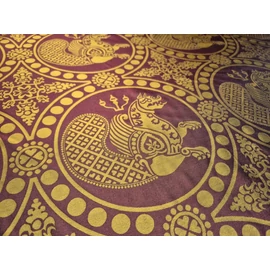
Famous Early Medieval Pattern: The Bahram Gur Horse-Archer Hunter Motif
The motif of Bahram Gur as a mounted archer and hunter is a well-known Early Medieval pattern. The version most widely circulated in Europe originated from a Byzantine workshop.
The depicted scene derives from Persian mythology, which the Byzantines also adopted and adapted. Silks featuring this motif have been found throughout Europe. The original Sassanid scene of Bahram Gur—the mounted king hunting various animals—was frequently depicted in silverware.
Bahram Gur was famed for his hunting prowess; the element Gur in his name reflects this obsession. Gur means “onager,” an animal often associated with King Bahram V. In Firdausi’s Shahnameh (Book of Kings), Bahram is said to have shot two onagers with the same arrow. This motif endured in later tales of Bahram, where it sometimes appears in a variant showing him shooting a lion and an onager with a single arrow.
Byzantine silk-weaving workshops incorporated oriental motifs but modified them to suit their own cultural context. For example, in the textile under discussion, crosses and alterations in the rider’s attire adapt the design to Byzantine sensibilities. This variation of the hunter scene was most likely produced during the 9th century.
The horse-archer motif from Moshchevaya Balka belonged to a textile with a large repeating pattern. The estimated original size of the medallion was approximately 110 cm in length and 80 cm in height.
We have a wide variety of finds of European silk fabrics featuring the Bahram Gur hunt, all of which were used for prestigious purposes. Some of the most significant examples include:
RUSSIA
The reconstructed textile from the garment from Pskov GERMANY ITALY • A large almost full preserved textile from the tomb of Sant’Emidio, from the crypt of the Cathedral of Ascoli Piceno.
CZECH REPUBLIC
FRANCE
Literature: Jerusalimskaya, A. A. Moshchevaja Balka. Saint Petersburg, 2012, pp. 98, 122–126.
Zubkova, E., Orfinskaya, O., and Mihailov, K. “Studies of the Textiles from the 2006 Excavation in Pskov.” In North European Symposium for Archaeological Textiles X (Ancient Textiles Series, Vol. 5). Oxford, 2010, pp. 291–298, fig. 49.8.
Březinová, Helena. “Magic of Silk: Byzantine Silk Fabrics.” In Lumír Poláček (ed.), Great Moravian Elites from Mikulčice. Brno, 2020, pp. 348–349, fig. 238.
Artwork: Balázs Szakonyi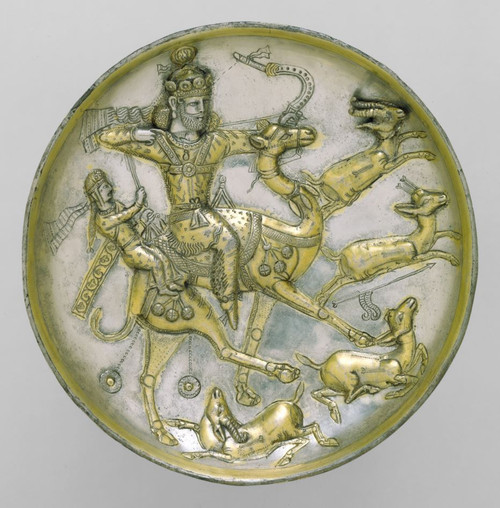
5th-century Sassanid plate with a hunting scene from the tale of Bahram Gur and Azadeh, Metropolitan Museum of Art
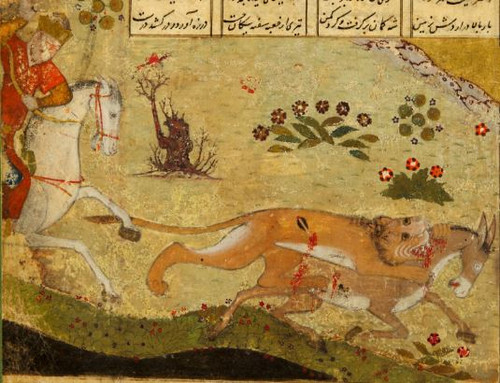
Illustrated leaf from a manuscript of Nizami’s Khamsa: Bahram Gur shooting a lion and an onager with one arrow.
Persia, probably Shiraz, Timurid period, ca. 1430–40 (Sotheby’s)
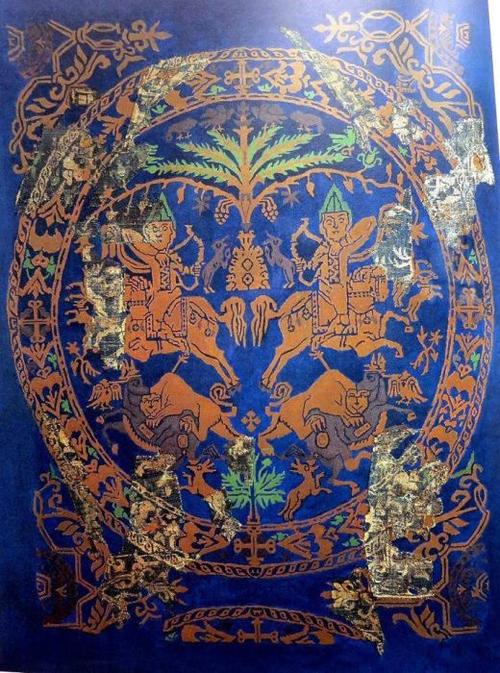
Reconstructed silk pattern from Moshchevaya Balka Fragments of this pattern originally formed part of the cuff of a kaftan sleeve;
the main framework follows the hunter silk from Cologne.
• From the famous sites of Moshchevaya Balka and Nizhny Arkhyz in the Caucasus
• From a 10th-century female burial in Pskov, where an underdress and an apron of blue tabby-woven linen were adorned with horse-archer silk

Width of the material: approx. 46 cm
• The most complete surviving specimen—closest to the fragments found in Moshchevaya Balka, and used as the basis for their reconstruction—is the silk of St. Kunibert in the Basilica of St. Cunibert in Cologne
• Two pieces incorporated into the golden altar of the Cathedral of San Ambrogio in Milan
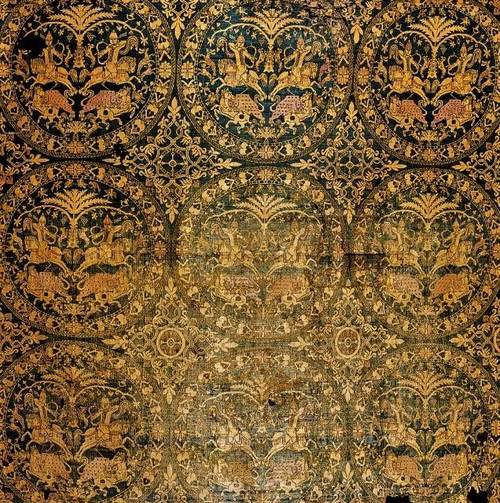
Horse-archer patterned silk from Ascoli Piceno.
Size of the whole textile: 122×150 cm
Size of the medallions: 40×43cm
• Two fragments decorating the binding of the 9th-century manuscript Gospel in the library of Strahov Monastery, Prague
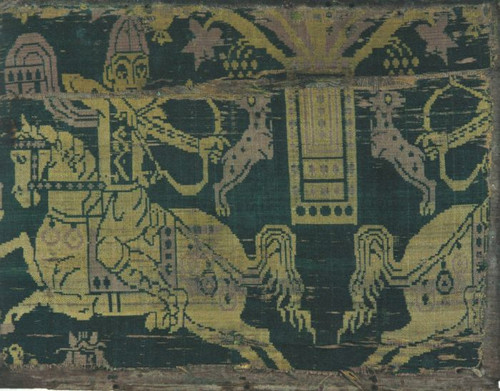
Piece of the hunter silk glued to the cover of a Gospel Book. Originating from a Frankish-Saxony region and dating around 870.
Size of the piece: 22×35 cm. Original size of the medallion: approximately 63 cm. (Prague)
• A fragment in the treasury of Saint-Calais Cathedral
• The cushion of Saint Remy in the Basilica of Saint Remy in Reims. Its relative chronology is notable: the pillow was covered with a 9th-century silk featuring senmurvs, while the inner stuffing consisted of a heavily worn piece depicting the Bahram Gur hunting scene.
• Small fragments, used as reliquary wrappings, preserved in Switzerland in the monastery treasury of Sonne (Sion?), in the cathedral of Saint-Étienne in Sens, France, and in the Kestner Museum in Hanover.
Online sources:
Plate with a hunting scene from the tale of Bahram Gur and Azadeh - The MET Museum
An illustrated leaf from a manuscript of Nizami’s Khamsa: Bahram Gur demonstrates his hunting prowess by shooting a lion and onager with one arrow, Persia, probably Shiraz, Timurid, circa 1430-40 - Shoteby's
Michele Picciolo: Tesori di fede: i tessili della sepoltura di Sant’Emidio
The historical source motif is reconstructed and graphically recreated by Kazar Bazar. The resulting reconstruction and original graphic work are protected by copyright. Reproduction, copying or commercial use without permission is prohibited.