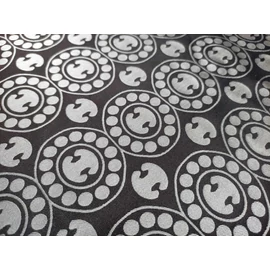
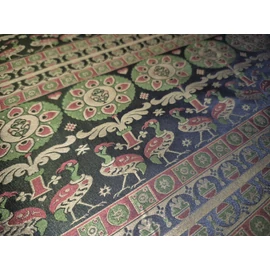
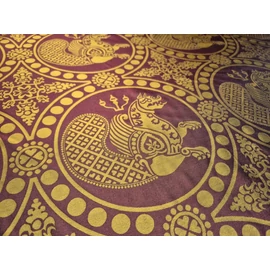
Description
Our silk pattern reconstruction is based on a textile preserved in the collection of the Basilica of Saint Servatius, Maastricht (Netherlands). The textile originally served as a wrapping for relics associated with Saint Martin of Tongeren.
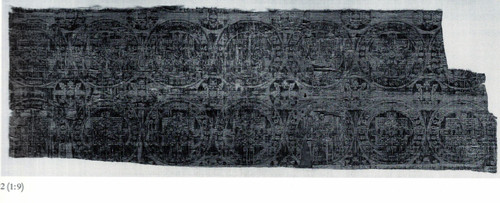
Picture of the original artefact (STAUFFER 1991)
The structure of the textile is characteristic of Central Asian silks, although similar examples are occasionally found among Byzantine products as well. Annemarie Stauffer dates the textile to the 10th century, while Gabriel Vial places it in the 11th–12th centuries. (STAUFFER 1991:52-54)
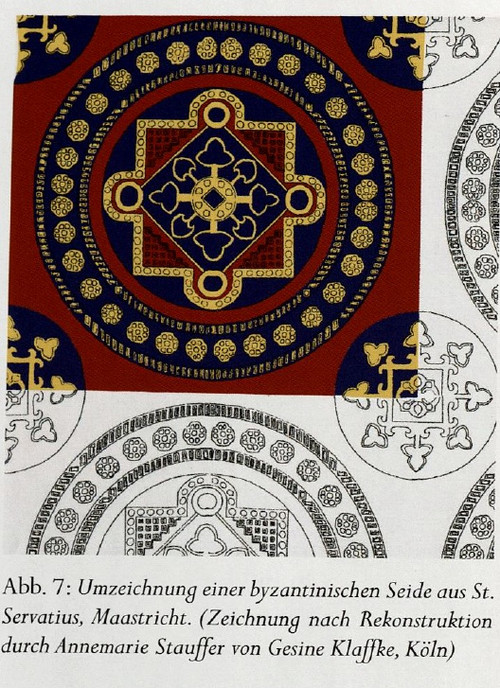
Source of our graphical reconstruction (SCHILP 2013)
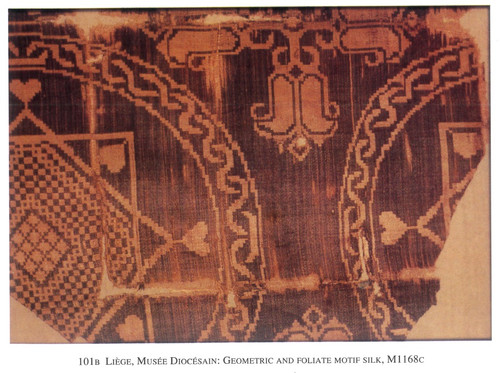
Several interesting parallels to this geometric pattern can be found among preserved silk collections across Europe. Such as the piece from the Musée Diocésian in Liége (Belgium). One notable example is a textile from the Musée Diocésain de Liège (Belgium). Muthesius dates its production to the 8th–9th centuries and maybe even beyond that. (MUTHESIUS 1997: 95-97)
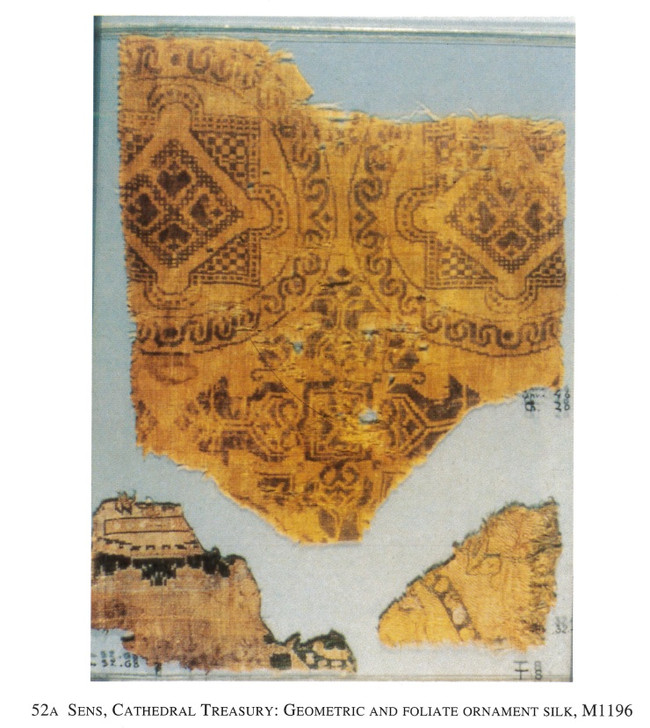
Another textile showing strong similarities to this group is preserved in the treasury of the Sens Cathedral Treasury (France). This piece is likewise dated to the 8th–9th centuries, or possibly later. Muthesius observes that these Central Asian silks exhibit strong Byzantine workshop influences, which may have been transmitted through the direct imitation of Byzantine models, including the re-weaving of imported silks traded between Byzantium and the Sogdian regions (MUTHESIUS 1997:98).
Interesting parallels can also be found among silk discoveries from the Northern Caucasus. The next textile discussed here was recovered from Moshchevaya Balka (Russia). According to its publisher, the textile incorporates both Byzantine and Sogdian motifs. Ierusalimskaja dates the silk to the 9th century (IERUSALIMSKAJA 2012:151)

Silk with an ornamental composition (IERUSALIMSKAJA 2012: FIG 82.)
Our final example is a fragment from a woman's cap, also discovered at Moshchevaya Balka. Ierusalimskaja dates this piece to the 8th–9th centuries (IERUSALIMSKAJA 2012:160).
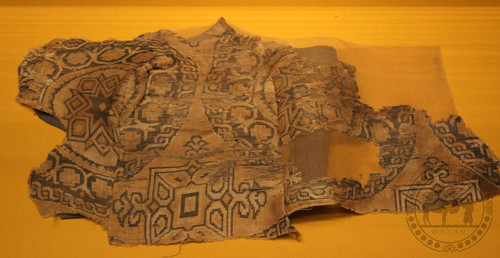
The geometric silk exhibited in the State Hermitage Museum
Photograph: János Mestellér, Kazar Bazar
Overall, the available evidence suggests that these geometrically patterned silks were most likely produced in Central Asia while exhibiting a strong Byzantine influence. Their dating remains uncertain. Although many examples are assigned to the 8th–9th centuries, other scholars have proposed dates extending into the 10th and even the 11th–12th centuries. Consequently, it seems reasonable to regard this type of geometric silk as suitable for historical reconstructions covering Western Europe or the nomads of Eastern Europe in the period from the 8th to the 10th century.
Sources:
Muthesius, Anna (1997). Byzantine Silk Weaving. AD 400 to AD 1200, Vienna.
Stauffer, Annemarie (1991). Die mittelalterlichen Textilen von St. Servatius in Maastricht, Bern.