Birka Silk

Description
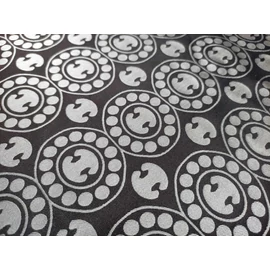
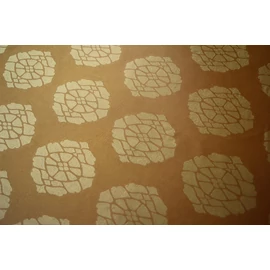
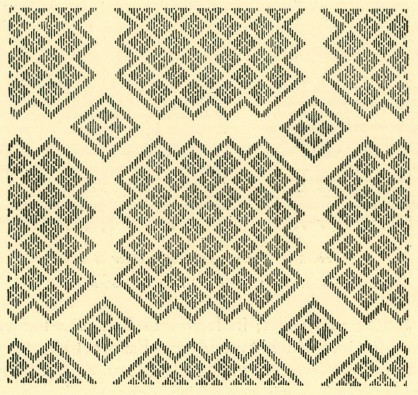
At the famous archaeological site of Birka (Sweden), numerous silk fragments were discovered. Geijer mentions approximately 45 unearthed graves with silk pieces. However, only one of these remained in a condition that allowed the pattern to be reconstructed — one fragment from grave Bj 944. It is possibly part of a hat. The pattern consists of alternating small squares and larger, stepped squares filled with small dots or stars. The fragment included a lace made of silver threads, which was sewn onto the textile. These silver threads played a major role in preserving both the silk and its pattern.
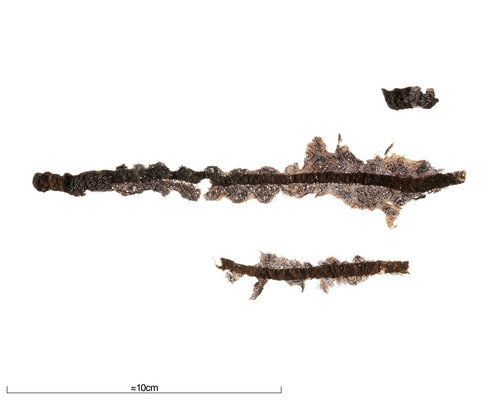
Picture of the original Birka silk: Ola Myrin, Historiska museet
The textile retained traces of blue color, likely evidence of material dyed with indigo. It featured a self-patterned weave of Chinese origin, specifically Han damask.
Additionally, the textile showed traces of gold, possibly indicating a block-printed or painted design on the material.
Grave Bj 944 belonged to a man buried with objects of oriental character, such as kaftan buttons. The grave could be dated around the middle of the 10th century.
Sources:
Geijer, Agnes: The Textile Finds from Birka, Birka III: Die Textilfunde aus den Gräbern, revised by the author Agnes Geijer, Stockholm, in Acta Archaeologica, pp. 209–222. 1980
Geijer, Agnes: Birka III: Die Textilfunde aus den Gräbern. 1938
Vlasatý, Tomáš: Evolution of Scandinavian long knives. Project Forlǫg – Reenactment and science 2020
Swedish History Museum, Stockholm - The Viking World
Artwork: Balázs Szakonyi
The historical source motif is reconstructed and graphically recreated by Kazar Bazar. The resulting reconstruction and original graphic work are protected by copyright. Reproduction, copying or commercial use without permission is prohibited.